


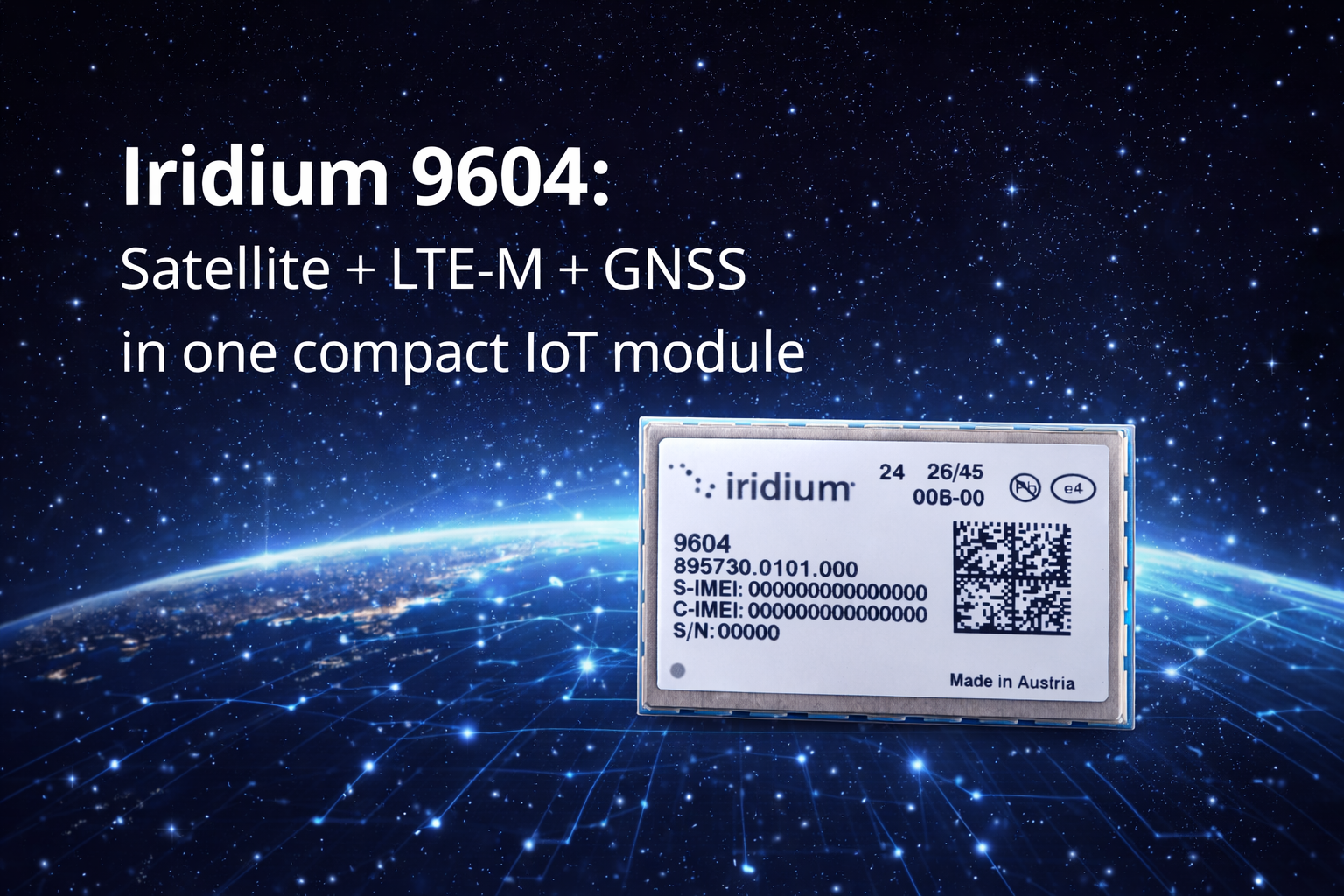
Iridium just announced the Iridium 9604—a compact, three-in-one IoT module that integrates:
- Iridium Short Burst Data® (SBD®) satellite connectivity
- LTE-M cellular connectivity
- GNSS positioning
…all inside a single platform designed for global, scalable IoT deployments. And yes—this is the kind of launch that unlocks entirely new product categories, not just incremental upgrades.
If you’ve ever tried to build a “works everywhere” tracker, sensor, or remote telemetry device, you already know the pain:
multiple radios, multiple antennas, more board space, complex power design, higher BOM cost, longer time-to-market… and then the real world shows up and breaks your assumptions.
The Iridium 9604 is aiming right at that bottleneck.
Official press release (Iridium): https://investor.iridium.com/2026-02-24-Iridium-Launches-Next-Generation-IoT-Platform
What makes the Iridium 9604 different?
1) Satellite + Cellular + GNSS in one module
Instead of designing around separate components (and the compromises that come with them), you can build a single device that:
- uses cellular where available
- automatically falls back to Iridium satellite when it’s not
- stays location-aware via GNSS so it can make smarter connectivity decisions
2) Smaller footprint, simpler device design
Iridium highlights that the 9604 delivers major board-space savings thanks to the 3-in-1 integration—up to 60%+ reduction versus multi-component designs—while also simplifying your power architecture and overall system integration.
3) Built for high-volume, cost-sensitive deployments
This is a big deal. “Dual-mode global IoT” has often been possible—but not always economically viable at scale. The 9604 is positioned to make those deployments realistic across industrial, infrastructure, and mobility use cases.
4) A truly compact form factor
Iridium states the 9604 is built on the u-blox SARA-R5 platform and comes in a 16 mm x 26 mm x 2.4 mm form factor—small enough to fit where global connectivity previously couldn’t.
Why this matters for Apollo Satellite clients
Most companies don’t want “satellite-only” or “cellular-only.”
They want confidence:
- “It reports when it’s in coverage.”
- “It still reports when it’s not.”
- “We don’t lose assets, visibility, compliance, or safety data because the map turned gray.”
The Iridium 9604 is a big step toward devices that feel like they have a single, intelligent network behind them—rather than two separate systems duct-taped together.
Real-world solutions this accelerates (right now)
Below are practical applications we already see across the field—where the 9604 can reduce complexity and push deployments into “finally makes sense” territory.
Asset tracking that doesn’t lie
Perfect for high-value mobile assets that move in and out of coverage:
- containers and trailers
- rental fleets and heavy equipment
- generators, pumps, compressors
- oilfield / utility job-site assets
Upgrade with 9604: keep your costs and message frequency optimized using LTE-M when available, while maintaining “always reachable” satellite fallback for remote or off-grid segments.
Remote monitoring for critical infrastructure
For assets that must be monitored even when networks fail or don’t exist:
- water and wastewater systems
- pipeline valves and pump stations
- power distribution equipment and remote substations
- renewable energy sites (solar, wind, microgrids)
Upgrade with 9604: create a single hardware design that can ship globally and still report alarms, run-hours, fault states, and maintenance flags reliably.
Mobility and field operations with location-aware reporting
For organizations that need movement + position + connectivity resilience:
- emergency management and disaster-response staging
- municipal / DOT equipment visibility
- mining and aggregate operations
- remote construction projects
Upgrade with 9604: use GNSS for smarter reporting rules (geofences, route exceptions, unauthorized movement) while keeping communications alive beyond cellular.
What Iridium is signaling strategically (and why you should care)
In the press release, Iridium frames the 9604 as part of a broader architecture that gives customers three IoT service paths:
- Iridium SBD, including the 9604 (satellite + cellular + GNSS in one module)
- Iridium NTN Direct (standards-based direct-to-device using third-party chips)
- Iridium Messaging Transport (IMT®) for larger payload capabilities via the Iridium Certus 9704
Translation: Iridium is building an IoT portfolio where you can choose the right “lane” depending on payload size, deployment scale, and device design goals—without abandoning the reliability of Iridium’s global L-band network.
Hypothetical solutions that push this tech to the limit
These are the “if we can do this cheaply enough, the world changes” scenarios.
1) The “global digital leash” for everything that moves
Imagine any mission-critical asset becoming trackable and reachable anywhere:
- high-value shipments
- specialty medical transport
- hazardous materials
- defense and government equipment
- rescue caches and emergency supplies
With the 9604-style integration, the device becomes simpler, smaller, and easier to mass deploy—so visibility becomes the default, not the exception.
2) Sensor swarms in the most hostile places on Earth
Deploy hundreds (or thousands) of small sensors to collect environmental or operational data:
- wildfire early detection
- remote watershed monitoring
- avalanche / landslide risk zones
- polar research and maritime domain awareness
Cellular is used when available, satellite fills the gaps, and GNSS makes the data map-ready without extra components.
3) “Always-on compliance” for regulated operations
Think of operations where missing data is expensive:
- cold chain verification (pharma/food)
- emissions monitoring and reporting
- safety and inspection audit trails
- critical maintenance logs that must be provable
A location-aware, multi-network module reduces the risk of “no data because no coverage” and makes compliance more defensible.
4) Next-generation autonomous systems
Autonomous platforms need resilient comms:
- unmanned surface vessels
- remote robotics
- drones operating beyond LTE footprints
- machine fleets in remote mining/construction
Dual-mode + GNSS in a single module can reduce the payload and integration overhead for platforms that already have extreme size, weight, and power constraints.
Availability timeline (what to do now)
Iridium indicates:
- Commercial availability begins in June 2026
- An Iridium 9604 Development Kit will be available for testing satellite and cellular services
If your roadmap includes global devices, multi-region deployments, or you’re trying to lower cost and complexity on a dual-mode design—this is the moment to plan.
Want to build something with this? We can help.
Apollo Satellite works with companies that need:
- device + connectivity strategy (satellite, cellular, or hybrid)
- service plan selection and provisioning guidance
- deployment planning (regions, reporting cadence, power profiles)
- scaling from prototype → production
If you want to be early to market with the 9604 class of capability, reach out and tell us:
- what you’re building
- where it will be used
- what data you need to send (and how often)…and we’ll help map the fastest path from concept to deployment.


Comments